
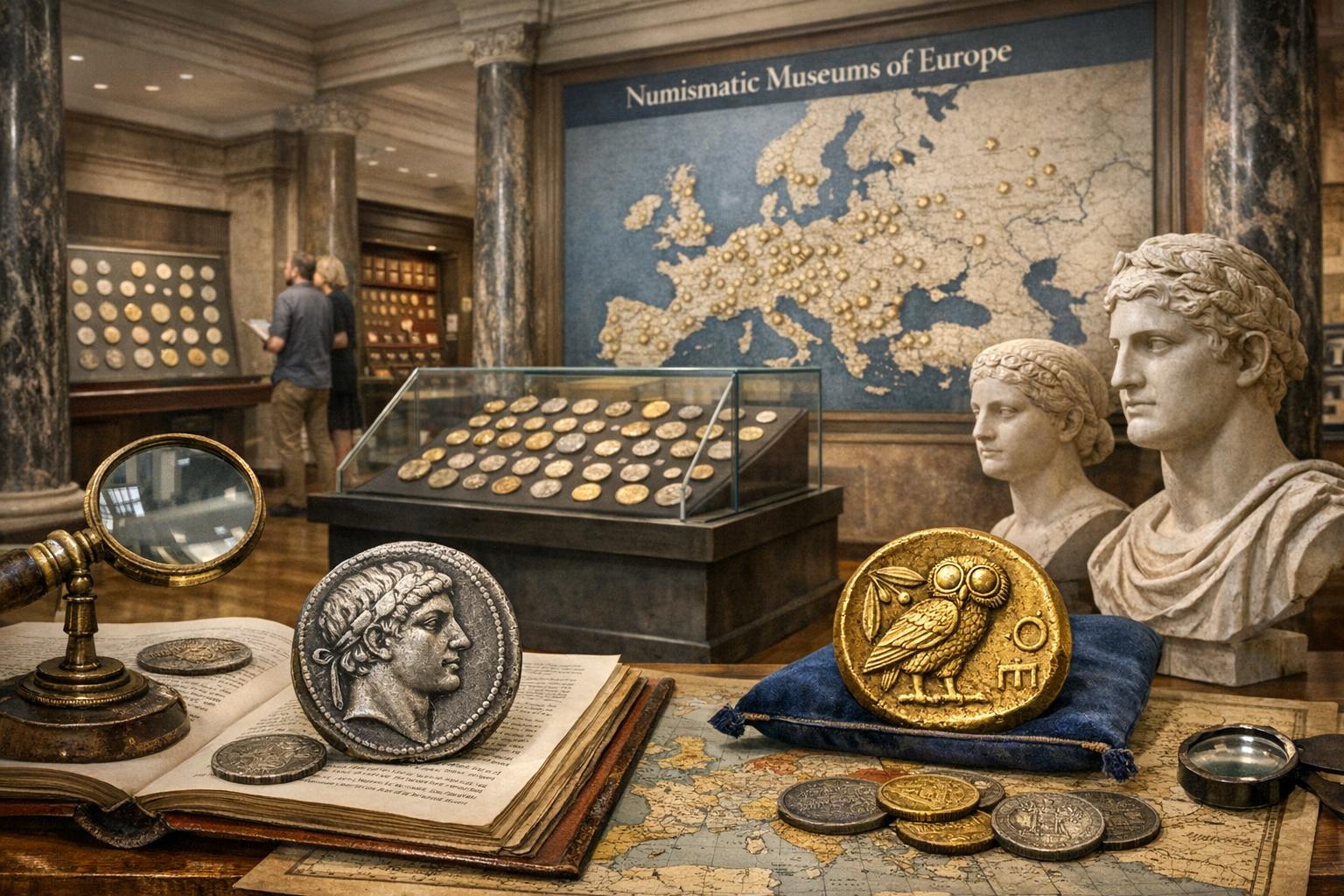
The Role of Numismatic Museums in Preserving History
Numismatic museums in Europe play an essential role in preserving and interpreting historical currencies, coins, and related monetary artifacts. These institutions act as custodians of objects that once circulated within economies but now serve as primary evidence of past societies. Coins and currency are not merely instruments of exchange; they carry inscriptions, iconography, and material characteristics that reflect political authority, technological capabilities, and cultural identity. By curating extensive and carefully documented collections, numismatic museums provide structured access to these materials, enabling both specialists and the general public to explore long-term developments in economic systems and governance.
The significance of numismatic collections lies in their durability and standardization. Unlike many other historical artifacts, coins are often precisely datable and geographically attributable. This makes them particularly valuable for constructing chronological frameworks and tracing political changes such as the rise and fall of empires or shifts in territorial control. Museums preserve these objects under controlled conditions, ensuring that their physical and informational integrity remains intact over time.
Educational Value
The educational contributions of numismatic museums extend beyond simple display. These institutions contextualize monetary objects within broader historical narratives, helping visitors understand how currency relates to trade, taxation, and social organization. Exhibitions are typically organized thematically or chronologically, guiding audiences through developments such as the transition from barter systems to coinage, the spread of standardized minting practices, and the eventual emergence of paper currency and digital payment systems.
Many European numismatic museums incorporate interpretive tools such as labeled displays, digital reconstructions, and comparative exhibits. These features assist visitors in identifying differences in design, weight, and composition across time periods. For example, the debasement of coinage—where precious metal content is reduced—can be used to illustrate economic stress or political instability. Educational programming often includes lectures, seminars, and guided tours that provide additional layers of analysis, making complex concepts in economic history more accessible without oversimplifying them.
For students and early-career researchers, numismatic museums function as practical learning environments. Handling sessions, where replicas or supervised original items are examined, allow individuals to develop observational and analytical skills that cannot be acquired through textbooks alone. This direct engagement strengthens understanding of material culture and reinforces the importance of empirical evidence in historical study.
Preservation of Cultural Heritage
Numismatic museums are central to the preservation of cultural heritage across Europe. Their collections include coins, medals, banknotes, minting tools, and archival records, all of which contribute to a comprehensive understanding of monetary history. These items often originate from archaeological excavations, private collections, or institutional transfers, and each acquisition is carefully cataloged and authenticated.
Preservation efforts rely on controlled environments where temperature, humidity, and light exposure are regulated to prevent deterioration. Metallic objects, for example, are susceptible to corrosion, while paper currency requires protection from light and environmental fluctuations. Conservation specialists employ non-invasive techniques to stabilize artifacts while maintaining their original condition. The goal is not to restore items to a perceived ideal state, but to preserve their authenticity as historical evidence.
In addition to physical preservation, digital documentation has become increasingly important. High-resolution imaging and database systems allow museums to record detailed information about each object, including provenance, composition, and condition. This not only safeguards knowledge in case of damage or loss but also facilitates remote access for researchers who cannot visit in person. Through these combined efforts, numismatic museums ensure that cultural heritage remains available for future generations.
Research Opportunities
Numismatic museums serve as important centers for academic research. Their collections provide primary source material for investigations into economic history, metallurgy, archaeology, and art history. Researchers use coins to study trade networks, monetary policies, and patterns of circulation. For instance, the distribution of specific coin types across regions can reveal the extent of commercial exchange or political influence.
Collaboration between museums and academic institutions is common, often resulting in joint research projects, publications, and conferences. These partnerships contribute to the refinement of dating methods, classification systems, and analytical techniques. Scientific approaches such as isotopic analysis and metallurgical testing have expanded the scope of numismatic research, allowing scholars to identify the origin of raw materials and understand production technologies.
Museums also support independent researchers by providing access to archives, study rooms, and expert консультации from curators. Catalogs and reference collections maintained by these institutions are essential tools for verifying the authenticity and classification of coins. Through their role as research hubs, numismatic museums contribute to the broader field of historical inquiry and help address gaps in existing knowledge.
Cultural and Economic Insight
Coins and currency provide a distinctive perspective on cultural and economic conditions. The imagery found on coins—such as portraits of rulers, religious symbols, or national emblems—reflects the priorities and identity of issuing authorities. Inscriptions can indicate language use, political titles, and ideological messaging, offering insight into how power was represented and communicated.
Economic information is also embedded in monetary artifacts. Variations in metal content, weight standards, and minting frequency can indicate shifts in resource availability, inflation, or fiscal policy. For example, a sudden increase in low-value coin production may suggest attempts to address shortages in small-scale transactions. Similarly, the introduction of new denominations often corresponds to changes in trade practices or administrative reforms.
Numismatic collections also provide evidence of cross-cultural interaction. Coins discovered outside their region of origin point to trade routes, migration, or military activity. By examining these patterns, historians can reconstruct networks of exchange that are not always documented in written sources. This makes numismatic evidence particularly valuable for studying periods or regions with limited textual records.
Popular Numismatic Museums in Europe
Europe is home to several prominent numismatic museums that hold extensive and diverse collections. The British Museum in London contains one of the largest coin collections in the world, spanning ancient civilizations to modern states. Its holdings include rare specimens that illustrate the development of coinage across different cultures.
The Monnaie de Paris, one of the oldest minting institutions still in operation, combines a functional mint with a museum that explores the history of French currency. Its exhibitions highlight both historical production methods and contemporary coin design. In Greece, the Numismatic Museum of Athens offers a comprehensive overview of ancient Greek coinage, with particular emphasis on classical and Hellenistic periods. The museum’s collection provides valuable context for understanding the economic and political dynamics of ancient city-states.
Other notable institutions include the Kunsthistorisches Museum in Vienna and the Bode Museum in Berlin, both of which maintain significant numismatic departments. These museums contribute not only to public education but also to ongoing scholarly work in the field.
Conclusion
Numismatic museums in Europe fulfill multiple essential functions, ranging from preservation and education to research and cultural interpretation. By maintaining and studying collections of currency and related artifacts, these institutions provide a structured means of examining historical developments in economy, politics, and society. Their work supports both academic inquiry and public understanding, ensuring that monetary history remains accessible and relevant.
Through conservation efforts, educational programming, and collaborative research, numismatic museums continue to expand knowledge about the past while safeguarding material evidence for the future. Their role is both custodial and interpretive, bridging the gap between historical artifacts and contemporary audiences.