
The Historical Context of Christianity in European Art
Christianity has played a central role in shaping the artistic traditions of Europe across many centuries. Its influence extends beyond subject matter, affecting techniques, themes, institutional structures, and the purposes of artistic production. From late antiquity through the modern period, Christian belief systems informed not only what artists created but also why and for whom they worked. The relationship between art and religion in Europe is therefore not incidental; it is foundational to understanding the development of visual culture across the continent.
The spread of Christianity across the Roman Empire and later throughout medieval Europe established a shared visual language that could communicate religious narratives to diverse populations. Artistic production was closely tied to theological ideas, liturgical practices, and ecclesiastical authority. As a result, much of Europe’s surviving artistic heritage reflects both religious devotion and institutional priorities, preserved in churches, monasteries, and later in public museums.
Early Christian Art and Its Impact
The earliest forms of Christian art emerged in a context where the religion was not yet dominant and sometimes faced persecution. As a result, early Christian imagery often relied on indirect or symbolic representation rather than explicit depictions. Common symbols such as the fish, the anchor, and the figure of the Good Shepherd allowed believers to communicate shared meanings discreetly. These symbols were frequently found in catacomb paintings and funerary objects, suggesting a focus on salvation and the afterlife.
Following the Edict of Milan in 313 CE and the subsequent adoption of Christianity as the state religion of the Roman Empire, artistic production expanded significantly. Churches were constructed on a larger scale, and decoration became more elaborate. Mosaics, frescoes, and sculptural elements began to depict biblical scenes more directly. Artistic style during this period often emphasized clarity and symbolic meaning over naturalistic representation, reflecting the priority placed on conveying theological truths rather than visual realism.
The development of basilica architecture also marked an important shift. These structures provided large interior spaces for congregational worship and offered extensive surfaces for artistic decoration. Apse mosaics depicting Christ as a ruler or judge became a standard feature, reinforcing doctrinal authority through visual means.
The Role of the Church in Artistic Patronage
During the medieval period, the Church emerged as the dominant patron of the arts in Europe. This patronage was institutional rather than individual, encompassing bishops, monastic orders, and later the papacy. Artistic production was largely directed toward religious purposes, including worship, instruction, and the reinforcement of doctrine.
One of the most significant developments of this period was the construction of cathedrals. These architectural projects required the collaboration of architects, masons, sculptors, and glassmakers. Gothic cathedrals, in particular, introduced structural innovations such as pointed arches and flying buttresses, allowing for taller buildings and larger windows. These windows were often filled with stained glass that depicted biblical narratives and the lives of saints, functioning as visual teaching tools for congregations.
Illuminated manuscripts also played a critical role in medieval artistic culture. Produced primarily in monastic settings, these works combined text and image in highly detailed compositions. The use of gold leaf, intricate patterns, and stylized figures reflected both the sacred nature of the content and the skill of the artisans. Although literacy was limited, these manuscripts contributed to the preservation and dissemination of religious knowledge.
Sculpture during this period often adorned church portals and interiors. Figures were integrated into architectural frameworks, reinforcing the unity between structure and decoration. The depiction of scenes such as the Last Judgment at cathedral entrances served as a reminder of moral and eschatological themes central to Christian teaching.
The Renaissance: A Period of Flourishing Art
The Renaissance introduced new approaches to art, characterized by a renewed interest in classical antiquity and a focus on proportion, perspective, and the study of the human form. While secular subjects became more common, Christianity remained a major source of inspiration and patronage. Wealthy individuals, civic institutions, and religious authorities all commissioned works that reflected both religious devotion and cultural prestige.
Artists such as Leonardo da Vinci, Michelangelo, and Raphael integrated scientific observation with theological subject matter. Techniques such as linear perspective and anatomical accuracy enhanced the visual impact of religious scenes. In works like The Last Supper, Leonardo employed composition and gesture to convey narrative clarity and psychological complexity. Michelangelo’s frescoes in the Sistine Chapel, including The Creation of Adam, combined monumental scale with detailed human anatomy, reflecting both biblical content and classical influence.
The role of the artist also evolved during this period. Rather than being viewed solely as craftsmen, artists increasingly gained recognition as intellectuals. This shift was supported by humanist thought, which emphasized the value of individual achievement and the study of classical texts. Even so, many Renaissance artworks continued to serve liturgical or devotional purposes, particularly in churches and chapels.
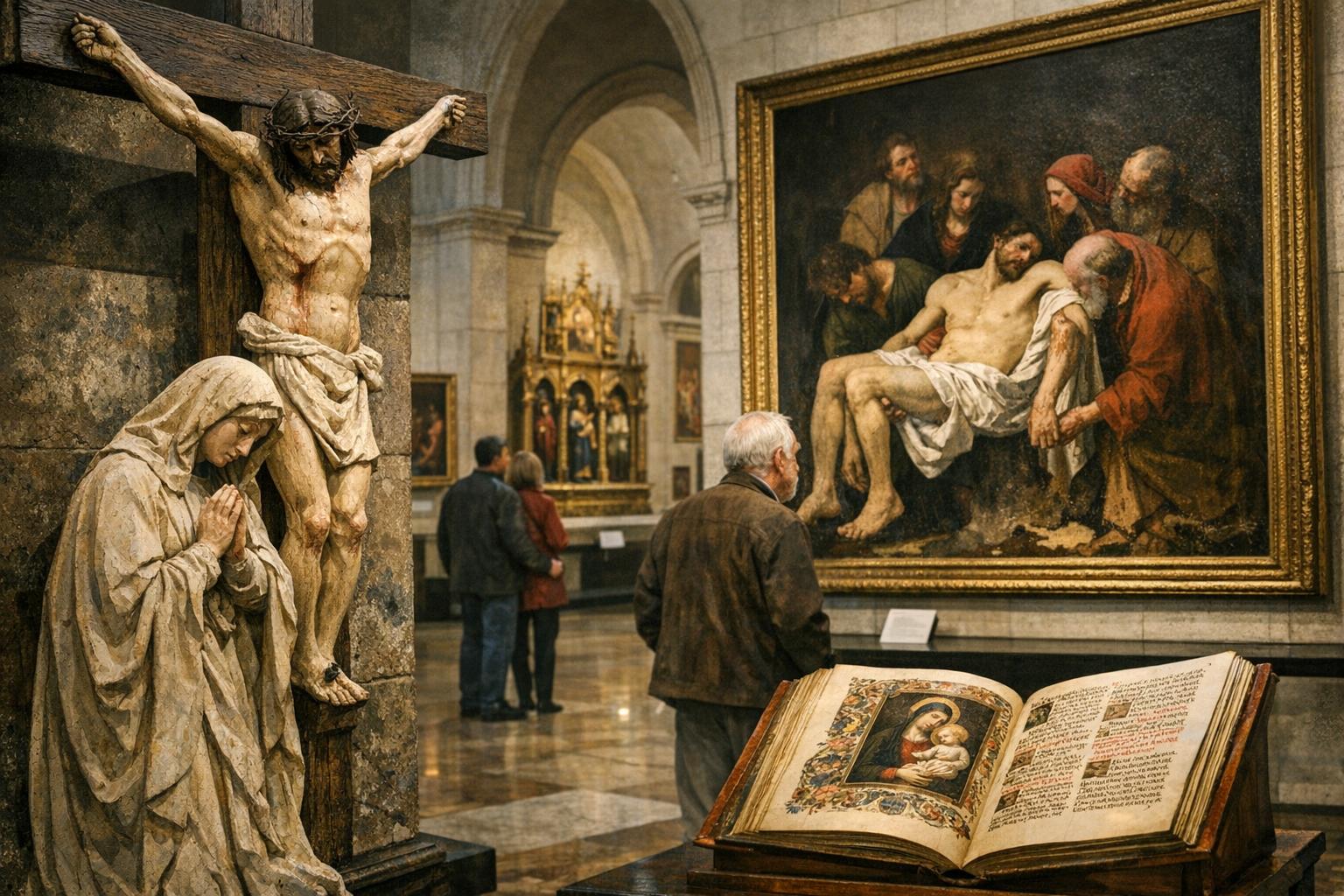
Museums today preserve many of these works, providing context for their original function while also presenting them as objects of aesthetic and historical value. The relocation of such works from sacred to secular spaces has influenced how they are interpreted by contemporary audiences.
Baroque to Romanticism
The Baroque period followed the Renaissance and introduced a more dynamic and theatrical approach to art. This shift was closely connected to the Counter-Reformation, during which the Catholic Church sought to reaffirm its influence in response to Protestant movements. Art became a means of engaging viewers more directly, emphasizing clarity, movement, and dramatic contrasts of light and shadow.
Artists such as Caravaggio used strong chiaroscuro to create a sense of immediacy and physical presence. His depictions of religious scenes often featured ordinary individuals as models, grounding spiritual narratives in recognizable human experience. Similarly, Gian Lorenzo Bernini’s sculptures combined technical precision with expressive movement, as seen in works that capture moments of transformation or revelation.
In Protestant regions, artistic production took a somewhat different direction. While religious subjects did not disappear, there was often a greater emphasis on secular themes and everyday life. Nevertheless, biblical references and moral symbolism remained present, indicating the continued influence of Christian thought.
During the Romantic period, the influence of Christianity became more varied and sometimes less overt. Artists explored themes related to nature, individual experience, and the concept of the sublime. Religious imagery did not disappear but was often integrated into broader reflections on existence and morality. This marked a transition toward more व्यक्तिगत and interpretive engagements with Christian ideas.
Christianity’s Enduring Legacy in Contemporary Art
In modern and contemporary art, Christianity continues to function as both a source of inspiration and a subject of critical examination. The relationship between art and religion is no longer governed by a single institutional framework, allowing for a wider range of perspectives. Some artists draw on traditional iconography, reinterpreting familiar images in new contexts. Others engage with religious themes conceptually, addressing questions of belief, identity, and cultural heritage.
The shift toward abstraction and experimentation in modern art has changed the visual language through which religious ideas are expressed. Symbolism may be less explicit, but references to Christian traditions can still be identified in form, composition, or thematic concerns. Contemporary exhibitions often place historical religious works alongside modern interpretations, highlighting both continuity and transformation.
Museums across Europe continue to play a key role in presenting the history of Christian art. Institutions such as the Uffizi Gallery, the Prado Museum, and the Vatican Museums offer extensive collections that illustrate the evolution of styles and themes over time. By situating artworks within broader historical narratives, these institutions help viewers understand the complex interactions between religion, culture, and artistic production.
The legacy of Christianity in European art remains significant not only because of the quantity of surviving works but also because of the enduring frameworks it established. Concepts of representation, symbolism, and artistic purpose developed within a religious context continue to influence how art is created and interpreted today.