
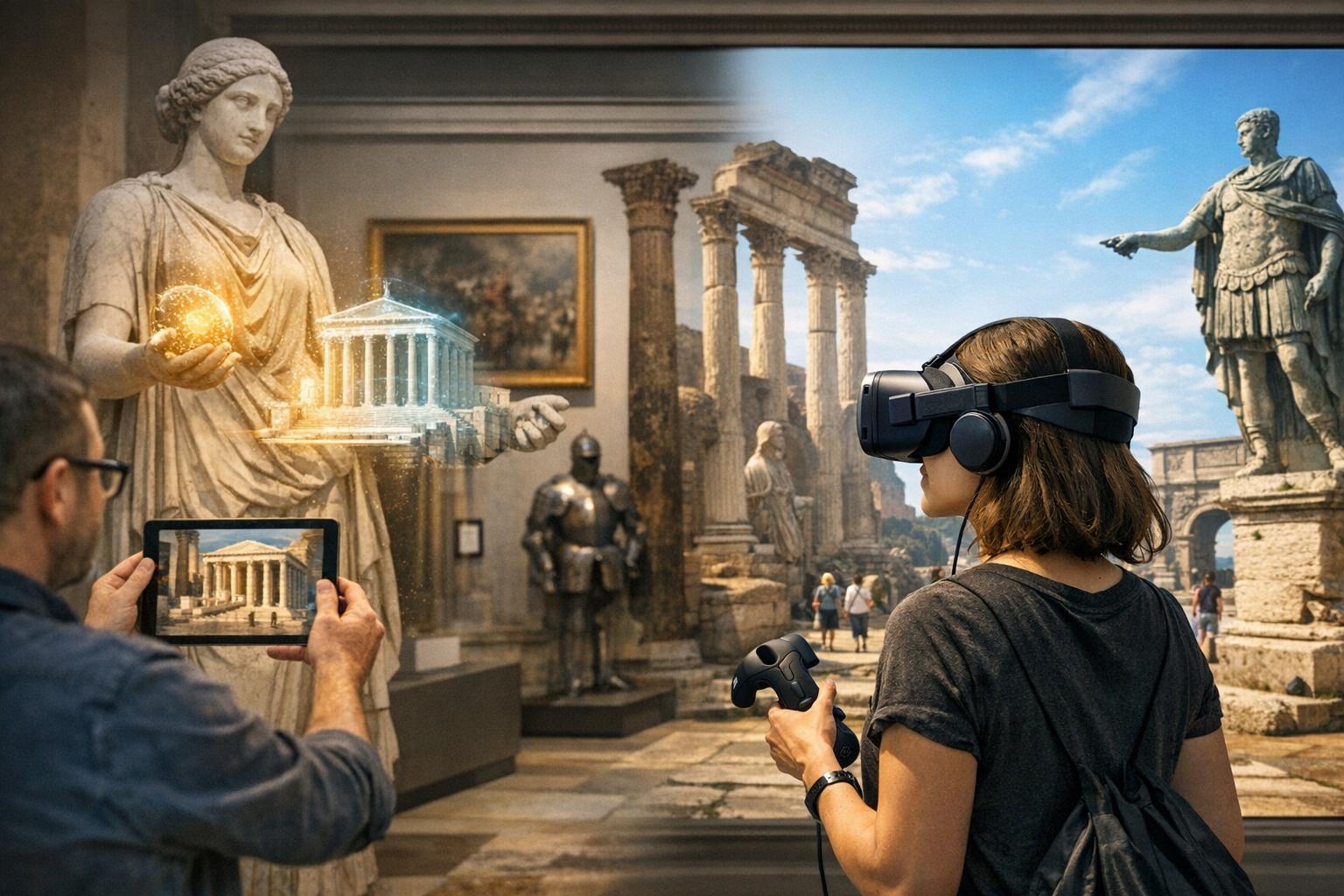
The Integration of Virtual Reality and Augmented Reality in European Museums
European museums are increasingly incorporating advanced digital technologies, particularly Virtual Reality (VR) and Augmented Reality (AR), into their exhibitions and programming. This integration reflects a broader institutional shift toward interactive, visitor-centered experiences that extend beyond traditional display methods. Rather than presenting artifacts as static objects, museums are using these tools to provide layered interpretation, contextual depth, and alternative modes of engagement. As a result, visitors can access historical, artistic, and cultural content in ways that are more dynamic and adaptable to individual learning preferences.
The adoption of VR and AR is also closely linked to the evolving expectations of audiences who are familiar with digital media. Museums across Europe are responding by transforming how collections are interpreted, making them more accessible both on-site and remotely. These technologies support multilingual content delivery, interactive storytelling, and personalized exploration paths, all of which contribute to a more inclusive museum environment.
Virtual Reality: Creating Immersive Museum Experiences
Virtual Reality allows museums to construct fully immersive environments that replicate or reconstruct real and imagined spaces. Through VR headsets, visitors can experience locations that may be geographically distant, physically inaccessible, or no longer in existence. This capability is particularly valuable for exhibitions related to archaeology, ancient history, and architectural heritage.
The British Museum in London has developed VR experiences that place visitors inside the tomb of Pharaoh Tutankhamun. This application enables users to examine the structure and artifacts of the tomb in spatial detail, offering perspectives that would not be possible within physical exhibition constraints. By simulating the scale and context of the original site, VR helps convey a more accurate understanding of its historical significance.
Similarly, the Louvre in Paris has implemented VR to enhance the viewing of its most recognized works. The Mona Lisa exhibition, for example, uses VR to isolate the artwork in a controlled virtual environment where visitors can observe fine details without the physical limitations imposed by crowds or protective barriers. This approach not only improves visibility but also allows the integration of interpretive content, such as commentary on artistic techniques and historical context.
Beyond individual exhibits, VR is also used for virtual museum tours. These experiences enable remote audiences to explore galleries and collections from anywhere, supporting educational outreach and expanding institutional visibility. For further information on how VR is used in museums, visit the British Museum’s VR page.
Augmented Reality: Enhancing On-Site Visits
In contrast to VR, Augmented Reality enhances physical museum visits by overlaying digital elements onto the real-world environment. AR applications typically operate through smartphones, tablets, or wearable devices, allowing users to interact with exhibits without removing themselves from the gallery space. This integration maintains the authenticity of the physical object while adding interpretive layers.
The State Hermitage Museum in Saint Petersburg has implemented AR features that provide additional information about artworks when viewed through a device. Visitors can access artist biographies, historical background, and visual reconstructions that contextualize the pieces within broader cultural narratives. This approach supports both independent exploration and guided learning.
The Museo del Prado in Madrid offers an AR application that reveals underlying layers of paintings, including sketches and revisions made by the artists. By superimposing X-ray imagery onto the visible surface, the application illustrates the creative process and technical methods used in the production of artworks. This level of insight is typically limited to conservation laboratories, but AR makes it accessible to general audiences.
AR is also used to reconstruct damaged or incomplete artifacts. By digitally restoring missing elements, museums can present a more comprehensive view of objects while clearly distinguishing between original and reconstructed components. For a deeper understanding of AR applications in museums, you can explore the State Hermitage Museum’s AR webpage.
Challenges and Opportunities
The implementation of VR and AR technologies presents several operational and strategic challenges for museums. The initial investment in hardware and software can be significant, particularly for institutions with limited funding. In addition, maintaining these systems requires ongoing technical support, regular updates, and compatibility management as devices and platforms evolve.
Staff training is another important consideration. Museum professionals must develop new competencies related to digital content creation, user experience design, and technical troubleshooting. This often involves collaboration with external developers, which can introduce additional complexity in project management and long-term sustainability.
Despite these challenges, the opportunities associated with VR and AR are substantial. These technologies offer new ways to engage audiences who may not be attracted to traditional exhibitions. Younger visitors, in particular, are more likely to respond to interactive and multimedia experiences. Furthermore, digital tools enable museums to collect data on visitor behavior, which can inform future exhibition design and improve overall effectiveness.
Accessibility is another area where VR and AR provide measurable benefits. Virtual tours and remote experiences allow individuals who are unable to travel to access museum content. On-site AR applications can include features such as audio descriptions, sign language overlays, and adjustable interfaces, making exhibitions more inclusive for visitors with diverse needs.
The Impact on Conservation and Education
VR and AR technologies are also contributing to conservation and educational initiatives. Digital documentation of artifacts and sites allows museums to create detailed archives that can be used for research, restoration, and preservation. In cases where cultural heritage sites are threatened by environmental factors or human activity, VR reconstructions can serve as long-term records.
In educational contexts, these technologies support interactive learning models that go beyond passive observation. Students can engage with historical scenarios, examine objects in three-dimensional space, and participate in simulated environments that reinforce curriculum content. Museums often collaborate with schools and universities to develop programs that incorporate VR and AR into formal education.
Additionally, these tools facilitate interdisciplinary research by combining data from fields such as archaeology, art history, and computer science. The resulting digital models can be shared among institutions, promoting collaboration and standardization in documentation practices.
For further insights into the impact of these technologies on conservation efforts, visit the conservation tech section of a prominent museum’s website.
In conclusion, the integration of Virtual Reality and Augmented Reality in European museums represents a significant development in how cultural heritage is presented and interpreted. These technologies enable institutions to expand their reach, improve accessibility, and offer more comprehensive and engaging experiences. While challenges remain in terms of cost and implementation, the continued advancement of VR and AR is likely to play a central role in shaping the future of museum practice.