
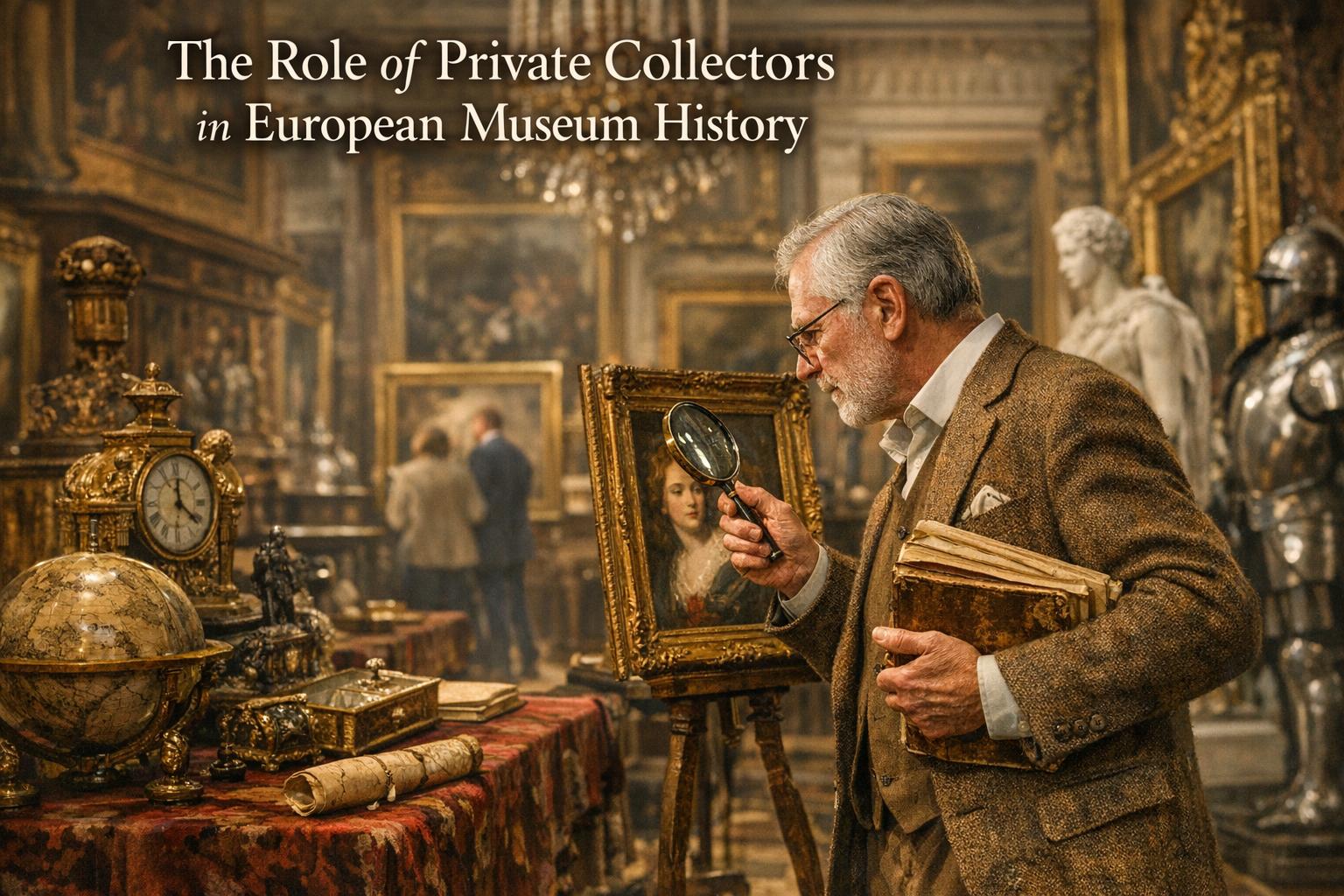
The Role of Private Collectors in European Museum History
The development of museums in Europe is closely connected to the activities and interests of private collectors. From the late medieval period through the nineteenth century, individuals with sufficient wealth and social standing assembled extensive collections of artworks, antiquities, natural specimens, and rare objects. These collections often reflected personal taste, intellectual curiosity, and the desire to demonstrate cultural authority. Over time, many such private holdings formed the basis of public museums, shaping not only their initial content but also their organizational principles and cultural roles. Examining private collectors provides insight into how museums evolved from exclusive, private repositories into institutions intended for broader public access.
Origins of Private Collections
In early modern Europe, collecting was closely tied to systems of patronage, scholarship, and social prestige. Aristocrats, merchants, and scholars developed collections that came to be known as Wunderkammern, or cabinets of curiosities. These collections did not follow modern categories but instead brought together a wide range of objects, including natural specimens, scientific instruments, ethnographic artifacts, and works of art. The goal was not only to gather rare items but also to present a microcosm of the known world within a single space.
The arrangement of these objects often reflected symbolic or aesthetic considerations rather than strict classification. Objects might be displayed according to visual similarity, rarity, or perceived wonder, rather than scientific taxonomy. Despite this lack of standardization, these collections played an important role in the development of knowledge systems. They encouraged observation, comparison, and discussion, contributing to emerging fields such as natural history and archaeology.
Private collectors also supported artists and craftspeople through commissions and purchases. During the Renaissance, figures such as the Medici family in Florence accumulated significant art collections while simultaneously fostering artistic production. Many works created under such patronage later entered museum collections, demonstrating how private ownership and artistic development were closely linked.
The Influence of the Enlightenment
The Enlightenment introduced new ways of thinking about knowledge, classification, and public access. Collectors began to shift from displaying objects as curiosities toward organizing them systematically according to emerging scientific principles. Classification systems based on taxonomy, chronology, and geography became more common, reflecting broader intellectual developments of the period.
This transformation influenced the structure and purpose of collections. Rather than serving solely as private displays of wealth or intellectual curiosity, collections increasingly took on educational functions. Scholars and collectors recognized the potential value of making objects accessible for study and public instruction. As a result, some private collections began to open to select audiences, including academics and members of learned societies.
The establishment of public museums during this period was closely tied to these developments. Institutions such as the British Museum, founded in 1753 and opened to the public in 1759, were built upon private collections assembled by individuals like Sir Hans Sloane. His extensive holdings of natural specimens, manuscripts, and artifacts were transferred to the public domain, forming a foundational collection for the museum. This model, in which private collections were converted into public institutions, became increasingly influential across Europe.
Significant Private Collections and Their Impact
Several prominent examples illustrate how private collectors contributed directly to the formation of major European museums. These cases highlight different pathways through which private ownership evolved into public heritage.
Catherine the Great and the Hermitage: In the eighteenth century, Catherine II of Russia systematically acquired artworks from across Europe. Her collection included paintings by artists such as Rembrandt, Rubens, and Van Dyck, as well as sculptures and decorative arts. Initially housed within the Winter Palace, the collection reflected both personal interest and imperial ambition. Over time, it expanded into what is now known as the Hermitage Museum. While originally accessible only to a limited audience, the collection eventually became a public institution, demonstrating how royal collecting practices could transition into national cultural assets.
Louvre and French Collectors: The Louvre’s transformation into a public museum during the French Revolution illustrates another trajectory. Prior to its opening in 1793, the Louvre served as a royal palace housing the collections of French monarchs. These collections themselves were the result of centuries of acquisition, including purchases, commissions, and diplomatic exchanges. During the الثورة, these royal holdings were nationalized and redefined as public property. Although not all items originated from private individuals in the traditional sense, the accumulation practices of monarchs functioned similarly to those of elite collectors. The resulting institution integrated these collections into a new framework emphasizing public access and national identity.
Ashmolean Museum: The Ashmolean Museum in Oxford represents one of the earliest examples of a purpose-built public museum. Established in 1683, it was based on the collection of Elias Ashmole, an antiquarian and scholar. Ashmole donated his collection to the University of Oxford, along with the requirement that a proper building be constructed to house and display the objects. The museum combined elements of a research institution and a public exhibition space, reflecting the dual goals of education and preservation. Its foundation illustrates how individual initiative could shape institutional development.
Legacy and Continuing Influence
The influence of private collectors did not end with the establishment of early museums. Throughout the nineteenth and twentieth centuries, donations and bequests continued to play a central role in expanding museum collections. Wealthy individuals often contributed artworks, manuscripts, and financial resources, enabling museums to grow and adapt to changing cultural expectations.
One example is the Thyssen-Bornemisza collection, assembled by a family of industrialists and eventually integrated into a major museum in Madrid. This collection added significant depth to existing public holdings, particularly in areas where representation had been limited. Such contributions demonstrate how private collecting continues to shape the scope and diversity of museum collections.
Private collectors have also influenced curatorial practices. Their methods of acquisition, categorization, and display have informed professional standards, even as museums have developed more formalized and academic approaches. The transition from private to public ownership required adjustments in documentation, conservation, and interpretation, leading to the development of modern museum practices.
At the same time, the role of private collectors has raised questions about access, ownership, and cultural property. Some collections were formed through means that are now subject to critical reassessment, including colonial acquisition and wartime appropriation. As museums continue to address these issues, the legacy of private collecting remains an important area of study and debate.
In summary, private collectors have played a central role in the formation and evolution of European museums. Their collections provided the initial material foundations for many institutions, while their practices influenced how objects were categorized and displayed. The transition from private ownership to public access reflects broader social and intellectual changes, particularly those associated with the Enlightenment. Today, the contributions of private collectors continue to shape museums, both through ongoing donations and through the historical frameworks they established.