
The Magnificent Museum Libraries of Europe
Europe boasts an exceptional network of museum libraries that combine intellectual heritage with architectural distinction. These institutions preserve centuries of thought across disciplines such as theology, science, philosophy, and the arts, while also serving as physical spaces designed to inspire study and reflection. Many of these libraries are integrated into museums, palaces, or religious complexes, linking collections of texts with broader cultural artifacts. Their dual role as research centers and historical landmarks positions them as essential components of Europe’s cultural infrastructure.
The Vatican Library, Vatican City
The Biblioteca Apostolica Vaticana, founded in 1475, stands as one of the most historically significant libraries in the world. Its holdings include tens of thousands of manuscripts, many of which originate from Late Antiquity and the medieval period. The collection spans theology, philosophy, classical literature, and early scientific inquiry, reflecting the intellectual priorities of the Catholic Church across centuries.
Architecturally, the Vatican Library is marked by long galleries, vaulted ceilings, and detailed frescoes. The decorative program is closely tied to themes of knowledge and divine order, reinforcing the library’s institutional purpose. Scholars from around the world access its collections for specialized research, though entry is restricted to qualified individuals. Preservation efforts include climate-controlled storage and digitization projects aimed at safeguarding fragile materials.
The British Library, London
The British Library is one of the largest libraries globally, housing more than 150 million items in multiple languages and formats. Although administratively independent, its historical association with the British Museum situates it within a broader context of national heritage preservation. Its collections include notable items such as medieval manuscripts, early printed books, maps, and sound recordings.
Unlike some older European libraries, the British Library’s architecture reflects modern design principles, prioritizing accessibility and functionality. The reading rooms are designed to accommodate large numbers of visitors, including researchers, students, and the general public. The institution also plays a leading role in digital archiving, ensuring that rare materials remain accessible beyond their physical location.
The Austrian National Library, Vienna
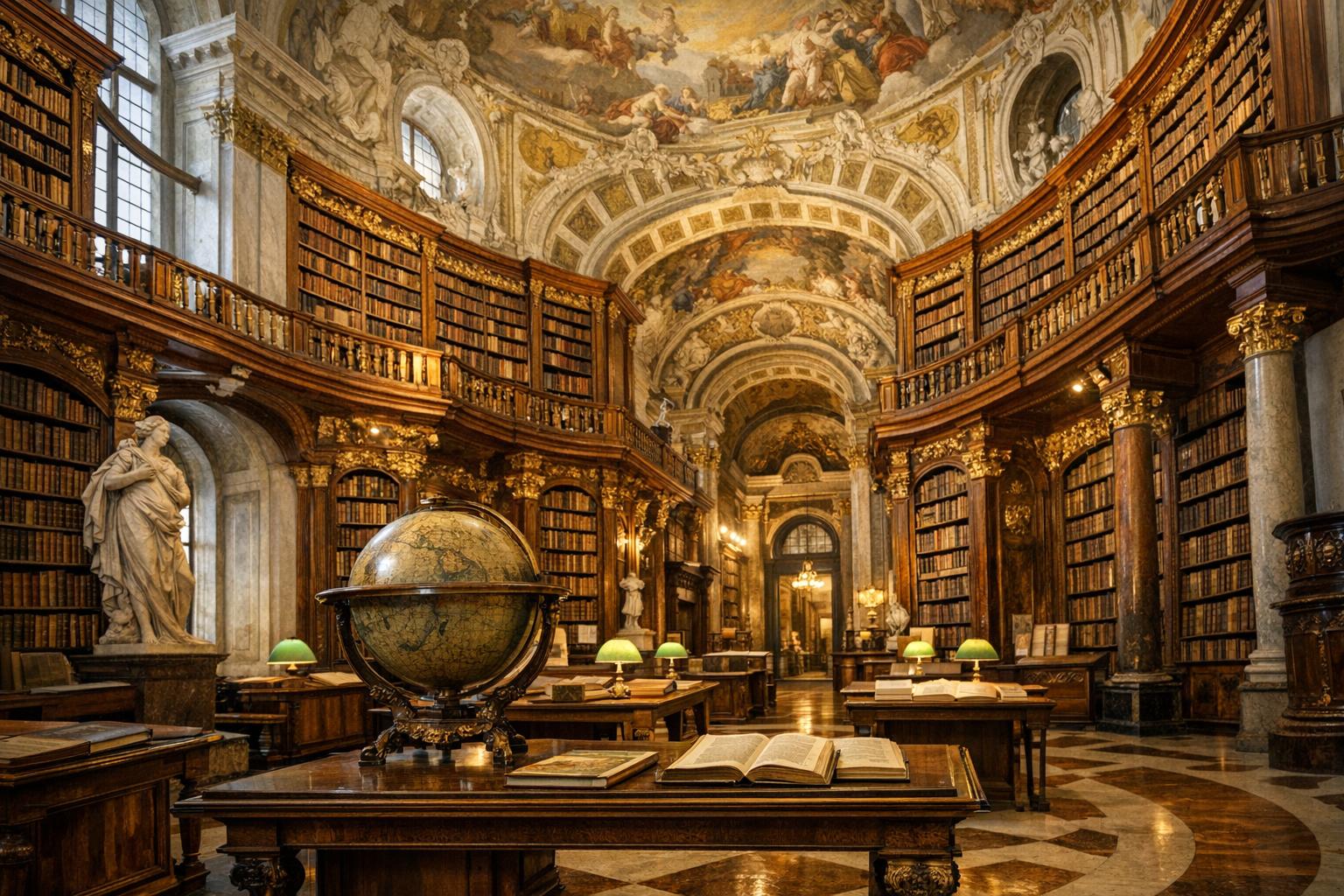
The Austrian National Library, located within Vienna’s Hofburg Palace, exemplifies Baroque architectural grandeur. Established under the Habsburg monarchy, the library was intended to demonstrate imperial authority through both intellectual and artistic achievement. Its most famous section, the State Hall, features a domed ceiling adorned with frescoes by Daniel Gran, depicting allegories of knowledge and enlightenment.
The collection includes manuscripts, globes, maps, and early printed works, with particular strength in European history and classical studies. Marble statues and ornate wooden bookcases contribute to the hall’s visual coherence, blending functionality with artistic expression. Today, the library functions as both a research institution and a museum space open to visitors.
The Library of El Escorial, Spain
The Library of El Escorial, located within the Monastery of San Lorenzo de El Escorial, was established in the 16th century under King Philip II of Spain. Designed as part of a larger royal and religious complex, the library reflects Renaissance ideals of order, symmetry, and intellectual unity. Its layout, with books arranged along walls beneath a barrel-vaulted ceiling, differs from earlier medieval libraries that emphasized enclosed storage.
The ceiling frescoes depict the liberal arts, including geometry, astronomy, and rhetoric, visually reinforcing the scope of the collection. The library holds manuscripts in Latin, Greek, Arabic, and Hebrew, highlighting Spain’s historical connections with diverse intellectual traditions. Preservation remains a central concern, given the age and fragility of many items.
The Marciana Library, Venice
The Biblioteca Nazionale Marciana is among the most significant libraries in Italy, located in Venice near St. Mark’s Square. Founded in the 16th century, it was initially enriched by the donation of Greek manuscripts from Cardinal Bessarion, reflecting Venice’s historical links with the Byzantine world. Over time, its collections expanded to include classical texts, maps, and early printed works.
The building itself is an example of Venetian Renaissance architecture, designed by Jacopo Sansovino. Interior spaces feature decorative ceilings and paintings by prominent artists, integrating artistic and scholarly functions. The Marciana Library continues to serve both as a repository of rare materials and as a cultural site open to the public.
Importance of Museum Libraries
Museum libraries occupy a distinct position within cultural institutions by combining curated collections of artifacts with extensive textual archives. This integration allows for a more comprehensive understanding of historical contexts, as written records can be studied alongside visual and material culture. Researchers benefit from access to primary sources that are often unavailable elsewhere.
In addition, these libraries contribute to national identity by preserving documents that reflect linguistic, political, and cultural development. Their collections often include legal texts, scientific treatises, and literary works that have shaped modern societies. As such, they support both academic research and public education.
Preservation of Historical Texts
One of the primary responsibilities of museum libraries is the preservation of fragile and often irreplaceable materials. Manuscripts, early printed books, and archival documents are susceptible to environmental damage, requiring controlled conditions for storage. Techniques such as temperature regulation, humidity control, and specialized binding repairs are routinely employed.
Digitization has become an increasingly important tool in preservation efforts. By creating high-resolution digital copies, institutions reduce the need for physical handling while expanding access to global audiences. However, digital preservation introduces its own challenges, including the need for long-term data storage and format standardization.
Access to Knowledge
Museum libraries play a key role in facilitating access to knowledge across different audiences. While some collections are restricted to specialists, many institutions provide public exhibitions, reading rooms, and educational programs. These initiatives support lifelong learning and promote engagement with historical materials.
Access policies vary depending on the rarity and condition of items, but the general trend is toward increased openness balanced with conservation requirements. By combining physical access with digital platforms, museum libraries extend their reach beyond traditional boundaries. This approach ensures that their collections remain relevant in a contemporary context while continuing to support scholarly inquiry.
In conclusion, Europe’s museum libraries represent a synthesis of intellectual history and architectural design. They function as custodians of knowledge, preserving materials that document centuries of human thought while providing spaces for ongoing research and education.